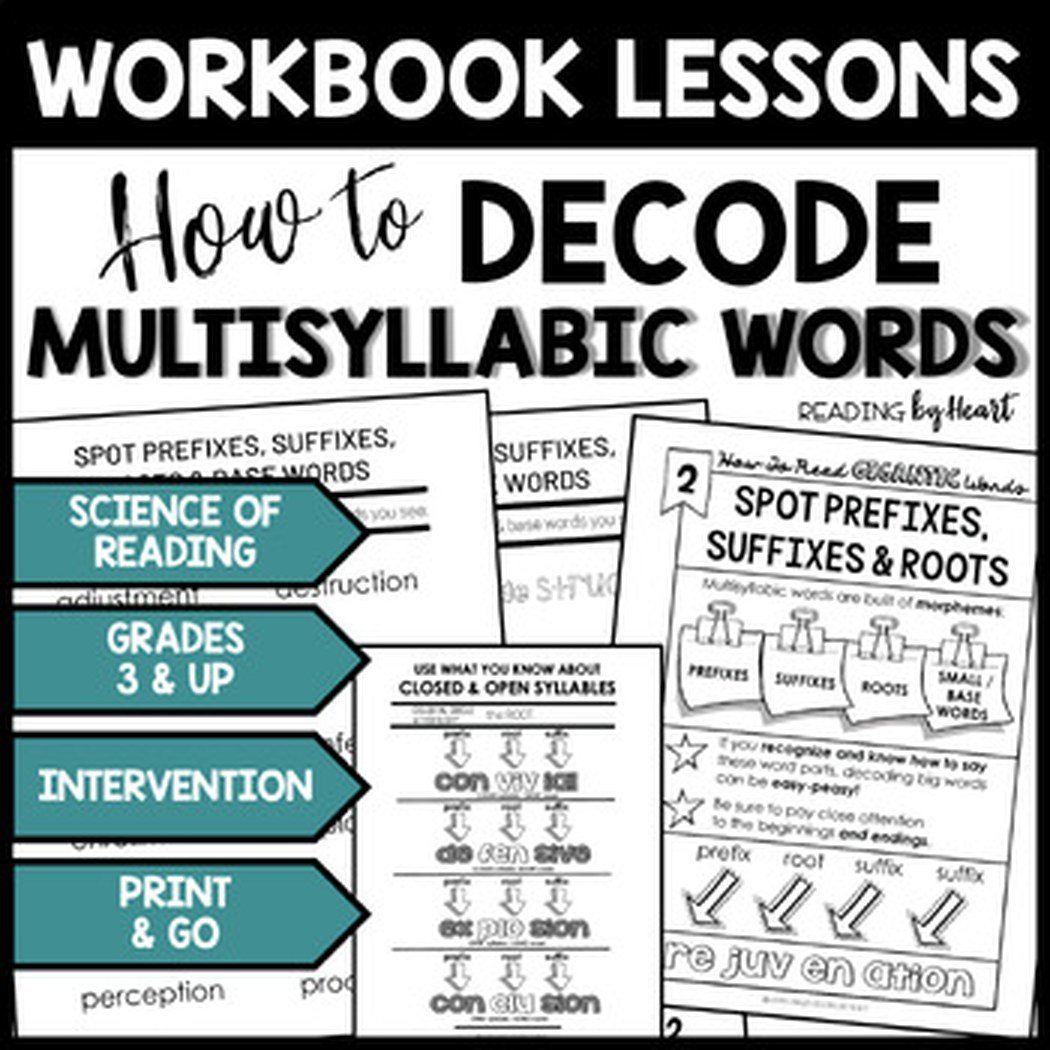
How to Read Gigantic Words: Guided Lessons (Grades 4-8)
Explicitly teach your 3rd, 4th, 5th grade upper elementary & middle school readers HOW TO decode multisyllabic words with confidence using this highly effective and engaging science of reading intervention.
Close the success gap!
Many older readers still struggle to decode multisyllabic words - hindering fluency and comprehension. Your struggling upper-grade readers will build CONFIDENCE, SKILL, EXCITEMENT and PRIDE as they experience success with gigantic words.
★ Highly motivating for readers who have previously struggled.
★ Builds advanced reading level skills.
★ Especially helpful for dyslexic and other readers who struggle to process multiple segments in words.
HOW TO USE
These best-selling GUIDED LESSONS take you and your students step-by-step through this proven morpheme-based strategy for decoding multisyllabic words.
Model and discuss as you walk your students through the mini-lesson presentations. Readers use the STUDENT WORKBOOK and their OWN DRY ERASE BOARDS. Students visualize and highlight parts of large words using circling, underlining, or highlighting.
INCLUDED
GUIDED LESSONS
•43-page STUDENT BOOKLET with guided practice pages
•TEACHER NOTES and SCRIPT to accompany the student booklet
REFERENCE MATERIALS
Reference materials are included for your use.
•Lists of 1000+ multisyllabic words, organized by syllable length and by word part
•Lists of 472 morphemes used to build multisyllabic words (affixes, roots and small words)
PLUS:
- COLLECTING WORDS ACTIVITIES
- INTERVENTION BINDER - print & digital.
- POWERPOINT SLIDESHOW / PDF
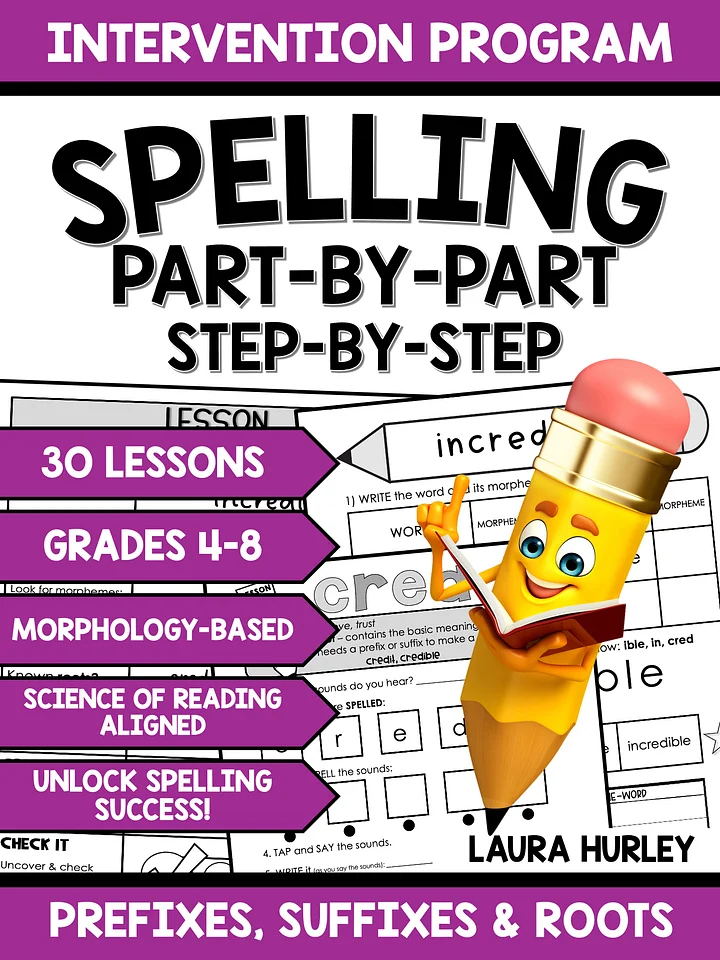
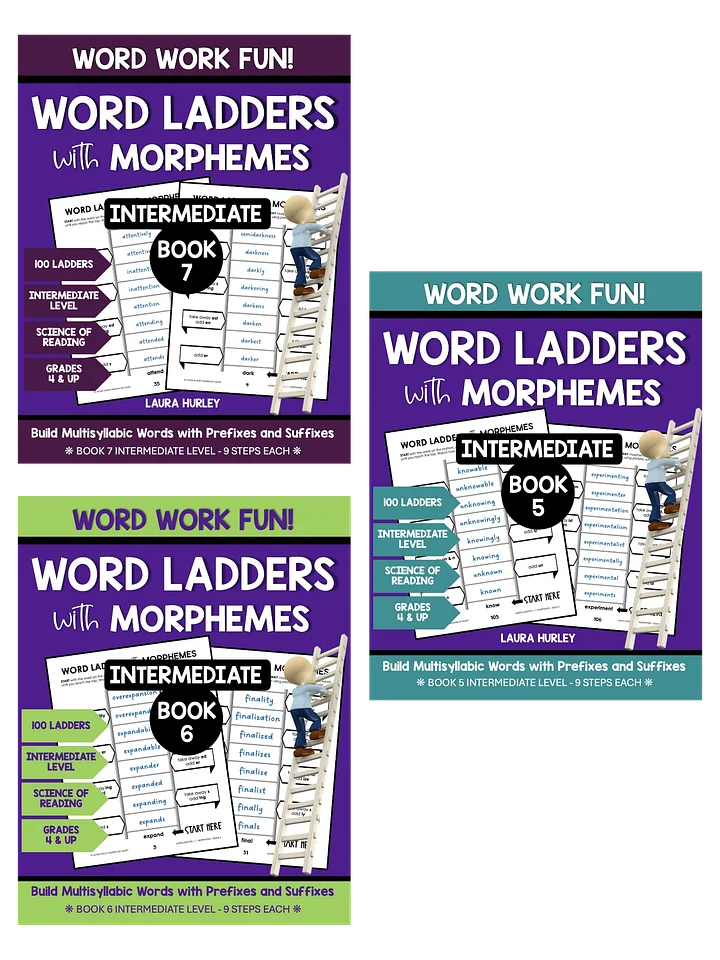
COMPANION RESOURCES AVAILABLE - more in-depth study of word parts:
DECODING MULTISYLLABIC WORDS MORPHEME WORD PARTS SCIENCE OF READING INTERVENTION
EXPLORE-A-WORD DECODING MULTISYLLABIC WORDS - GUIDED PRACTICE BUNDLE
THE RESEARCH
✔️ Science of Reading research (Ehri, Kilpatrick) shows that orthographically mapping word parts (morpheme chunks) helps consolidate the parts of words into memory so they can be read by sight, with automaticity. Readers are then able to segment and decode multisyllabic words easily. This is the most advanced stage of decoding - the grapho-morphemic stage.
✔️ This grapho-morphemic strategy teaches readers to spot & say the morphemes: prefixes, suffixes, roots and small base words in multisyllabic words, making reading gigantic words accessible to all! When readers are able to spot affixes, roots, and small words they automatically know, they don’t have to rely on sounding out long words letter-by-letter. This can be especially helpful for dyslexic readers.
★USE FOR★
•SMALL GROUPS
•INDIVIDUALS/TUTORING
•RTI INTERVENTION
•WHOLE GROUP
•SUMMER SCHOOL
•AT-HOME LEARNING
•VIRTUAL OR IN-PERSON
★RECOMMENDED FOR★
READING LEVEL: 2.0+
GRADE LEVEL: GRADES 3-12+
☛PLEASE NOTE:
This is a DECODING activity, with emphasis on readers’ ability to decode longer, multisyllabic words encountered as their reading levels progress. Study of Word Part MEANINGS is a separate vocabulary skill and is NOT covered by this activity.
☛PLEASE NOTE:
Words are NOT DIVIDED USING TRADITIONAL SYLLABICATION RULES!
This program DOES NOT use SYLLABICATION RULES to decode multisyllabic words. Rather, because multisyllabic words are made from morphemes (prefixes, suffixes, roots and base words) it employs a STRUCTURAL ANALYSIS approach, using morphemes to decoding multisyllabic words.
★COMMON CORE STANDARDS★
♦DECODE MULTISYLLABIC WORDS♦ CCSS 3.3b, 3.3c, 4.3a, 5.3a
★TEKS STANDARDS★
Demonstrate and apply phonetic knowledge by DECODING WORDS using knowledge of PREFIXES and SUFFIXES: 3.b.2.A (v) (vi), 4.b.2.A (iv) (v), 5.b.2.A (iv)
© Laura Hurley Reading by Heart
Questions? Email readingbyheart@gmail.com
Stay connected
Website: readingbyheart.com
Also visit: icanlearnathome.com
Facebook group: facebook.com/groups/readinginterventionolderreaders